Rethinking and Unthinking Development by Busani Mpofu Sabelo J. Ndlovu-Gatsheni
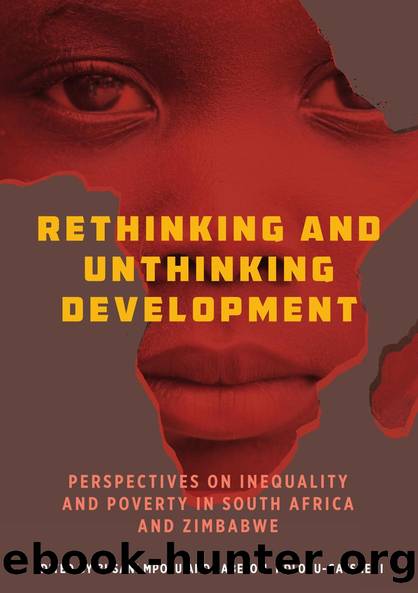
Author:Busani Mpofu, Sabelo J. Ndlovu-Gatsheni [Busani Mpofu, Sabelo J. Ndlovu-Gatsheni]
Language: eng
Format: epub
Tags: Nonfiction, Social & Cultural Studies, Political Science, Politics, Economic Conditions, Social Science
ISBN: 9781789201772
Publisher: Berghahn Books
Published: 2019-03-27T04:00:00+00:00
âStirring the Nestâ: BBBEE and the Native Club in South Africa
South Africa as a late decoloniser with an advanced industrial economy presents an interesting case in terms of assessing the trajectory of the National Democratic Revolution (NDR). Increasingly, the fissures of race, class and dispossession have occasionally boiled to the surface, but thus far the South African liberal democratic architecture negotiated by Nelson Mandela has held forth, although the fissures have already started to show. As early as 2000, Bond (2000) was arguing that South Africa had gone from apartheid to neoliberalism via an âelite transitionâ and a few years later, he would argue that South Africaâs political was âunsustainableâ. To begin with, the rate and intensity of what has been called âservice deliveryâ protests has increased and the black middle-class âimpatienceâ with the remnants of the apartheid economy has started to show in various ways. In 2006, a group of black intellectuals launched a Native Club and while its force seems to have petered out, here is why it was important:
the formation of the Native Club is not seen as an isolated event, but as a consequence of some embers which have been burning since the beginning of the struggle against apartheid and is situated historically within the broader terrain of power contestations and continuous reflections by different sections of South African society on the gains of the anti-apartheid struggle, post-apartheid development failures and disappointments as well as the future direction of democratic social and political transformation at this crucial second decade of South African democratic consolidation. (Ndlovu-Gatsheni 2007: 5)
Since then, significant political events have occurred: first, the expulsion of ANCYL leader Julius Malema led to the formation of the EFF and, second, the expulsion of the National Union of Miners in South Africa (NUMSA) from the Congress of South African Trade Unions (COSATU) has brought to the fore questions of whether the historical alliance between the ANC (as a political power) and COSATU (as a working-class power) will survive. While in power, the ANC has attempted to chip away slowly at the formidable apartheid economy dominated by whites and has halfheartedly attempted a land reform programme, which has been slow. The ANC, like ZANU (PF), has become a breeding ground for a parasitic and very consumptive black âcapitalist classâ, which is dependent on liberation credentials to muscle into BBBEE deals and, when this fails, access to state tenders has created another avenue for decadent accumulation. The ANC has left room for the EFF to emerge with a radical demagoguery, which the EFF claims is historically rooted in the tradition of the Freedom Charter â this is a distinguishing feature from the MDC in Zimbabwe that was burdened by âneoliberal triumphalismâ, and its policies were largely focused on economic growth and less on the need for âasset redistributionâ (like radical land reform).
Download
This site does not store any files on its server. We only index and link to content provided by other sites. Please contact the content providers to delete copyright contents if any and email us, we'll remove relevant links or contents immediately.
| Anthropology | Archaeology |
| Philosophy | Politics & Government |
| Social Sciences | Sociology |
| Women's Studies |
The Secret History by Donna Tartt(19092)
The Social Justice Warrior Handbook by Lisa De Pasquale(12190)
Thirteen Reasons Why by Jay Asher(8912)
This Is How You Lose Her by Junot Diaz(6888)
Weapons of Math Destruction by Cathy O'Neil(6281)
Zero to One by Peter Thiel(5802)
Beartown by Fredrik Backman(5756)
The Myth of the Strong Leader by Archie Brown(5509)
The Fire Next Time by James Baldwin(5447)
How Democracies Die by Steven Levitsky & Daniel Ziblatt(5219)
Promise Me, Dad by Joe Biden(5154)
Stone's Rules by Roger Stone(5088)
A Higher Loyalty: Truth, Lies, and Leadership by James Comey(4964)
100 Deadly Skills by Clint Emerson(4926)
Rise and Kill First by Ronen Bergman(4790)
Secrecy World by Jake Bernstein(4753)
The David Icke Guide to the Global Conspiracy (and how to end it) by David Icke(4720)
The Farm by Tom Rob Smith(4514)
The Doomsday Machine by Daniel Ellsberg(4490)
